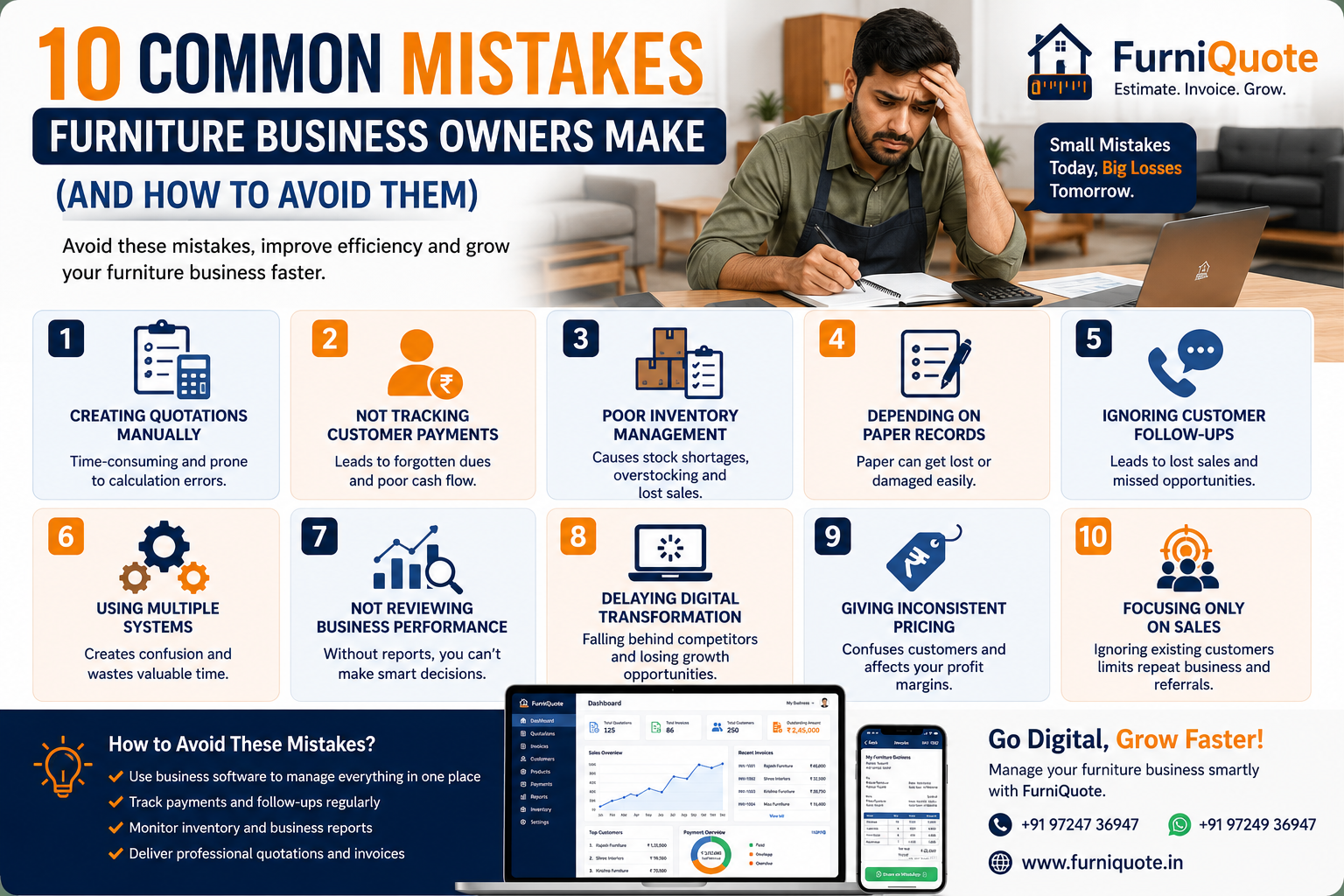
Running a furniture business is rewarding, but it also comes with daily challenges. From preparing quotations and managing inventory to tracking payments and maintaining customer relationships, every task plays a crucial role in your success.
Many furniture business owners unknowingly make mistakes that reduce profits, waste valuable time, and limit business growth. The good news is that most of these mistakes can be avoided with better planning and the right digital tools.
In this article, we'll explore the 10 most common mistakes furniture business owners make and how you can avoid them to build a more profitable and organized business.
1. Creating Quotations Manually
Many furniture businesses still prepare quotations using notebooks, Word documents, or Excel sheets. This process is slow and increases the chances of calculation errors.
Why it's a problem
- Takes too much time
- Pricing mistakes
- Difficult to update
- Looks less professional
How to avoid it
Use quotation software that automatically calculates totals, applies discounts, and generates professional PDF quotations you can instantly share with customers.
2. Not Tracking Customer Payments
One of the biggest reasons businesses face cash flow issues is poor payment tracking.
Many owners simply remember pending payments or write them in a diary.
Why it's a problem
- Forgotten dues
- Delayed collections
- Customer disputes
- Poor cash flow
How to avoid it
Maintain a digital customer ledger with payment history and outstanding balances.
3. Poor Inventory Management
Running out of stock or overstocking products directly affects profits.
Without proper inventory tracking, businesses often don't know what products are available.
Common issues
- Stock shortages
- Overstocking
- Lost sales
- Wrong purchase planning
Solution
Use inventory management software to monitor product availability and stock movement in real time.
4. Depending on Paper Records
Many furniture businesses still rely on notebooks for customer information, quotations, and payment records.
Paper records can easily be damaged or misplaced.
Better approach
Store all business information digitally with secure cloud backups so your data is always available.
5. Ignoring Customer Follow-Ups
A customer requesting a quotation today may buy next week or next month.
Many businesses lose sales simply because they never follow up.
Why follow-ups matter
- Builds trust
- Increases conversions
- Improves customer relationships
- Generates repeat business
Best practice
Schedule reminders to contact customers after sending quotations.
6. Using Multiple Systems
Some businesses use:
- Excel for products
- WhatsApp for quotations
- Notebook for payments
- Calculator for pricing
This creates confusion and wastes time.
Better solution
Use one business management system where quotations, invoices, products, customers, and payments are managed together.
7. Not Reviewing Business Performance
Many business owners work hard every day but never analyze their numbers.
Without reports, it's difficult to answer questions like:
- Which products sell the most?
- Which customers generate the highest revenue?
- How much profit did the business make this month?
Solution
Review monthly sales, payment, and customer reports to make informed business decisions.
8. Delaying Digital Transformation
Some furniture businesses believe software is only for large companies.
This misconception prevents them from becoming more efficient.
Reality
Even small furniture shops can benefit from digital tools by saving time and reducing errors.
Starting early provides a competitive advantage.
9. Giving Inconsistent Pricing
When prices are calculated manually, different customers may receive different quotations for the same product.
This creates confusion and reduces customer trust.
Solution
Maintain a centralized product catalog with updated prices to ensure consistent quotations.
10. Focusing Only on Sales
Many owners focus only on getting new customers while ignoring existing ones.
However, repeat customers are often more profitable.
Build long-term relationships by:
- Providing fast service
- Sending professional quotations
- Maintaining purchase history
- Following up after delivery
- Offering excellent customer support
Satisfied customers often become your best source of referrals.
Bonus Tips for Furniture Business Growth
Besides avoiding these common mistakes, here are a few additional ways to improve your business:
- Respond quickly to customer inquiries.
- Keep your product pricing updated.
- Use professional quotations and invoices.
- Track pending payments regularly.
- Analyze monthly business reports.
- Build a strong online presence through Google Business Profile and social media.
- Encourage customer reviews and referrals.
- Invest in software that saves time and improves efficiency.
How Technology Can Help
Modern furniture businesses are increasingly adopting digital solutions to streamline operations.
Business software can help you:
- Create quotations in minutes.
- Generate professional invoices.
- Track customer payments.
- Manage inventory.
- Store customer information.
- Access business data from anywhere.
- Generate detailed sales reports.
By reducing manual work, you can spend more time serving customers and growing your business.
Final Thoughts
Success in the furniture industry isn't just about selling great products—it's about running your business efficiently.
Avoiding these common mistakes can help you save time, improve customer satisfaction, increase cash flow, and grow your profits.
Whether you operate a furniture showroom, a manufacturing unit, a PVC furniture business, or a carpenter workshop, adopting organized processes and digital tools can make a significant difference in your day-to-day operations.
Small improvements today can lead to long-term business success.
Frequently Asked Questions (FAQs)
1. What is the biggest mistake furniture business owners make?
One of the biggest mistakes is relying on manual processes for quotations, billing, and payment tracking instead of using digital tools.
2. How can furniture businesses improve cash flow?
Track outstanding payments regularly, send timely reminders, and maintain a digital customer ledger.
3. Why is inventory management important?
Proper inventory management helps prevent stock shortages, reduces unnecessary purchases, and improves profitability.
4. How do professional quotations help increase sales?
Professional quotations create a positive first impression, improve customer trust, and make it easier for customers to make purchasing decisions.
5. Is business software suitable for small furniture shops?
Yes. Even small furniture businesses can benefit from software by saving time, reducing errors, and managing customers more effectively.
 Get on Play Store