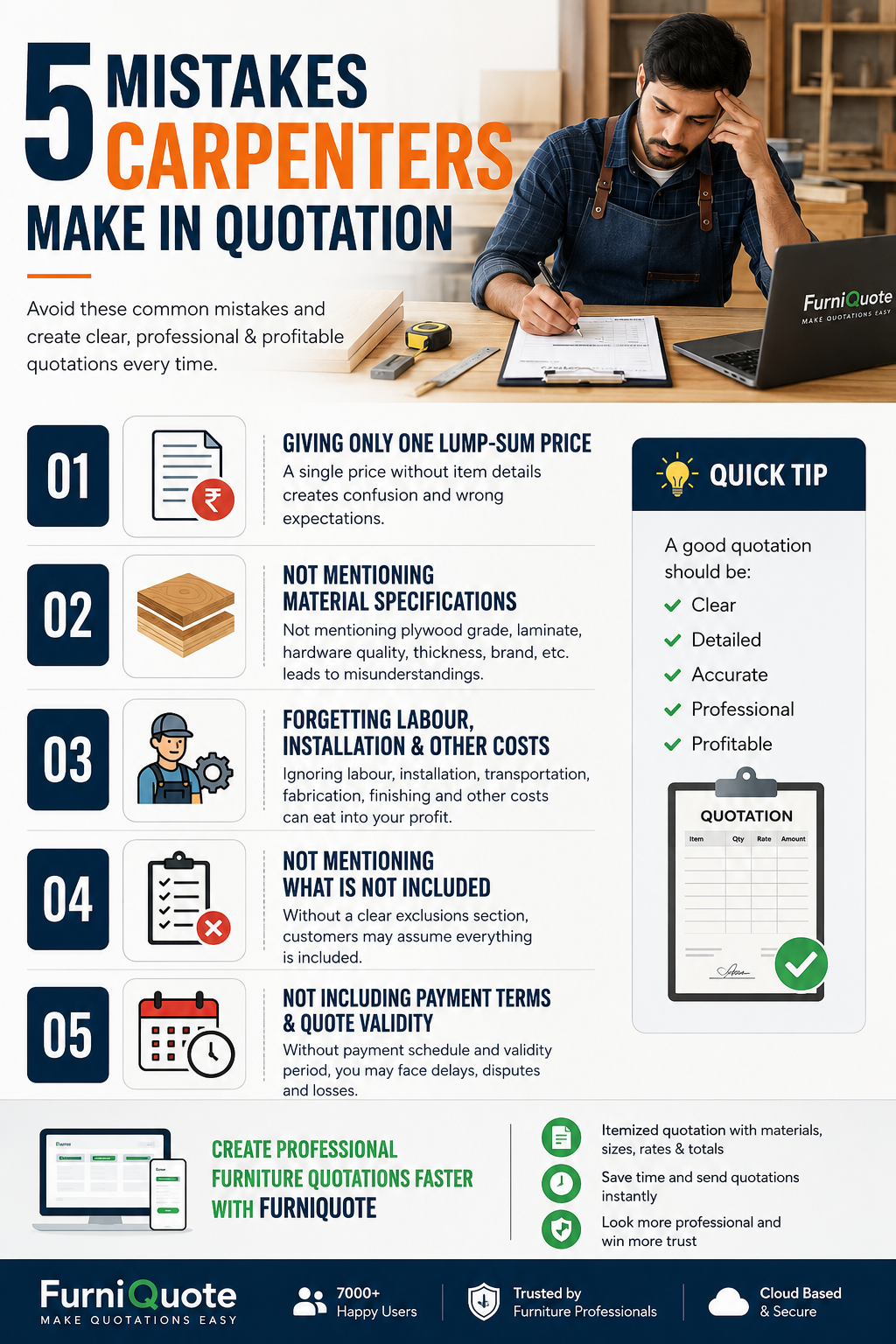
For a carpenter, a quotation is much more than a price written on paper. It is the foundation of the customer's understanding of the entire project.
Whether you are quoting a wardrobe, modular kitchen, TV unit, wooden bed, office furniture, or complete interior work, a clear quotation helps prevent confusion, protects your profit, and makes your business look professional.
But many carpenters still make simple quotation mistakes that can lead to underpricing, customer disputes, unexpected costs, and lost profits.
Here are the 5 most common quotation mistakes carpenters make—and how to avoid them.
1. Giving Only One Lump-Sum Price
One of the biggest mistakes is writing something like:
"Modular Kitchen – ₹1,50,000"
The customer sees the final number, but doesn't know what is included.
Does the price include:
Plywood?
Laminate or acrylic?
Hardware?
Handles?
Countertop?
Installation?
Transportation?
Labour?
GST?
When these details are not clear, customers may make assumptions that are different from what the carpenter intended.
How to avoid it
Break the quotation into clear items.
For example:
| Item | Specification | Quantity | Rate | Amount |
|---|---|---|---|---|
| Kitchen Base Cabinet | 18mm BWP Plywood | 12 RFT | ₹2,200 | ₹26,400 |
| Wall Cabinet | 18mm BWP Plywood | 10 RFT | ₹1,800 | ₹18,000 |
| Acrylic Shutters | Premium Acrylic | 45 SQFT | ₹900 | ₹40,500 |
| Hardware | Soft-close fittings | 1 Set | ₹15,000 | ₹15,000 |
| Installation | Site installation | 1 Job | ₹8,000 | ₹8,000 |
An itemized quotation makes it much easier for both the carpenter and customer to understand exactly what they are paying for.
2. Not Mentioning Material Specifications
Another common mistake is writing only:
"Plywood – ₹X"
Plywood can have different grades, thicknesses, brands, and applications. The same problem applies to laminates, MDF, HDHMR, acrylic, hinges, channels, handles, and other hardware.
For example, simply writing "18mm plywood" does not communicate the complete specification.
A better quotation can mention details such as:
Plywood thickness
Plywood grade
Brand, where relevant
Laminate thickness
Laminate finish
Hardware brand or quality
Hinge/channel type
Handle specification
This protects both sides from misunderstandings. FurniQuote's own quotation guidance similarly emphasizes specifying dimensions, material grades, hardware, and finishes rather than relying on vague descriptions.
Example
Instead of:
Wardrobe – 60 SQFT – ₹1,200/SQFT
Write:
Wardrobe – 18mm BWR plywood carcass, specified laminate finish, soft-close hardware, dimensions as approved – 60 SQFT – ₹1,200/SQFT
The second version gives the customer much more confidence in what they are buying.
3. Forgetting Labour, Installation and Other Costs
Many carpenters calculate the cost of plywood, laminate, hardware, and other materials—but forget some of the smaller costs involved in completing the project.
These can include:
Carpenter labour
Helper labour
Workshop fabrication
Installation
Transportation
Loading and unloading
Hardware fitting
Finishing
Site visits
Consumables
Cutting and wastage
When these costs are not included in the calculation, the quotation may look profitable at first but become unprofitable during execution.
How to avoid it
Before sending a quotation, calculate:
Material Cost + Hardware + Labour + Fabrication + Installation + Other Costs + Profit Margin = Final Price
For larger or custom jobs, separating fabrication and installation can also make the quotation easier to manage.
4. Not Mentioning What Is NOT Included
This is one of the most common causes of customer disputes.
A customer may assume:
"Everything related to the furniture is included."
The carpenter may think:
"I never included that in my price."
Both sides may genuinely believe they are correct.
For example, a kitchen quotation might not include:
Appliances
Plumbing work
Electrical work
Civil work
Countertop
Painting
Wall repair
Additional transportation
Changes requested after approval
How to avoid it
Add a clear Exclusions section to every quotation.
For example:
Exclusions:
Electrical work is not included.
Plumbing work is not included.
Appliances are not included.
Civil modifications are not included.
Additional work requested after quotation approval will be charged separately.
Any work outside the mentioned scope will require a revised quotation.
Clear exclusions help prevent the classic customer conversation:
"But I thought this was included."
A well-defined scope and exclusions section is widely recommended for carpentry quotations because it establishes exactly what the quoted price covers.
5. Not Including Payment Terms and Quote Validity
Some carpenters send a quotation with only the total amount.
For example:
Total: ₹2,75,000
But when should the customer pay?
How much advance is required?
When will fabrication begin?
When is the balance payment due?
How long is the quoted price valid?
These details are important, particularly because material prices and project requirements can change.
How to avoid it
Include clear payment terms such as:
Payment Terms
Advance: As agreed before material procurement
Progress payment: As per project milestone
Final payment: On completion/handover
Fabrication will begin after quotation approval and applicable advance payment.
Also include a quotation validity period, such as:
"This quotation is valid for 15 days from the date of issue."
The exact payment structure should match your business and project, but the important thing is to put the terms in writing.
Bonus: Don't Forget Quotation Numbers
A professional quotation should also have a unique quotation number.
For example:
Quotation No.: FQ-2026-0098
Also include:
Customer name
Project/site address
Quotation date
Carpenter/business name
Contact information
GST details, if applicable
Project description
Total amount
Payment terms
Terms & conditions
This makes it much easier to track quotations when you have multiple customers and projects.
Why Professional Quotations Matter for Carpenters
A good quotation does three important things:
1. Protects Your Profit
When materials, labour, installation, transportation, and other costs are properly calculated, you are less likely to forget expenses.
2. Builds Customer Trust
An itemized quotation looks more professional than a handwritten or WhatsApp message containing only one price.
3. Reduces Disputes
Clear specifications, scope, exclusions, and payment terms give both the customer and carpenter the same understanding of the project.
How FurniQuote Helps Carpenters Create Better Quotations
Creating every quotation manually can take valuable time.
With FurniQuote, carpenters and furniture businesses can create professional furniture quotations with itemized products, dimensions, material specifications, rates, quantities, totals, and business details.
Instead of repeatedly creating quotation formats from scratch, you can create a structured quotation and share it with your customer digitally.
For a carpenter handling multiple wardrobes, kitchens, beds, TV units, offices, or interior projects, a professional quotation system can make the entire quoting process faster and more organized.
Final Checklist Before Sending a Carpenter Quotation
Before sending your next quotation, ask yourself:
☑ Did I clearly describe the work?
☑ Did I mention dimensions and quantities?
☑ Did I specify materials and hardware?
☑ Did I calculate labour and installation?
☑ Did I include transportation and other applicable costs?
☑ Did I mention exclusions?
☑ Did I include payment terms?
☑ Did I mention quotation validity?
☑ Did I include my business details?
☑ Did I check the final price and profit margin?
If the answer is yes to all 10, your quotation is much more likely to be clear, professional, and profitable.
Create Better Furniture Quotations with FurniQuote
Stop relying on confusing handwritten estimates and manually formatted documents.
Create professional furniture quotations faster with FurniQuote.
Built for carpenters, furniture manufacturers, modular kitchen businesses, interior professionals, and woodworking businesses.
 Get on Play Store