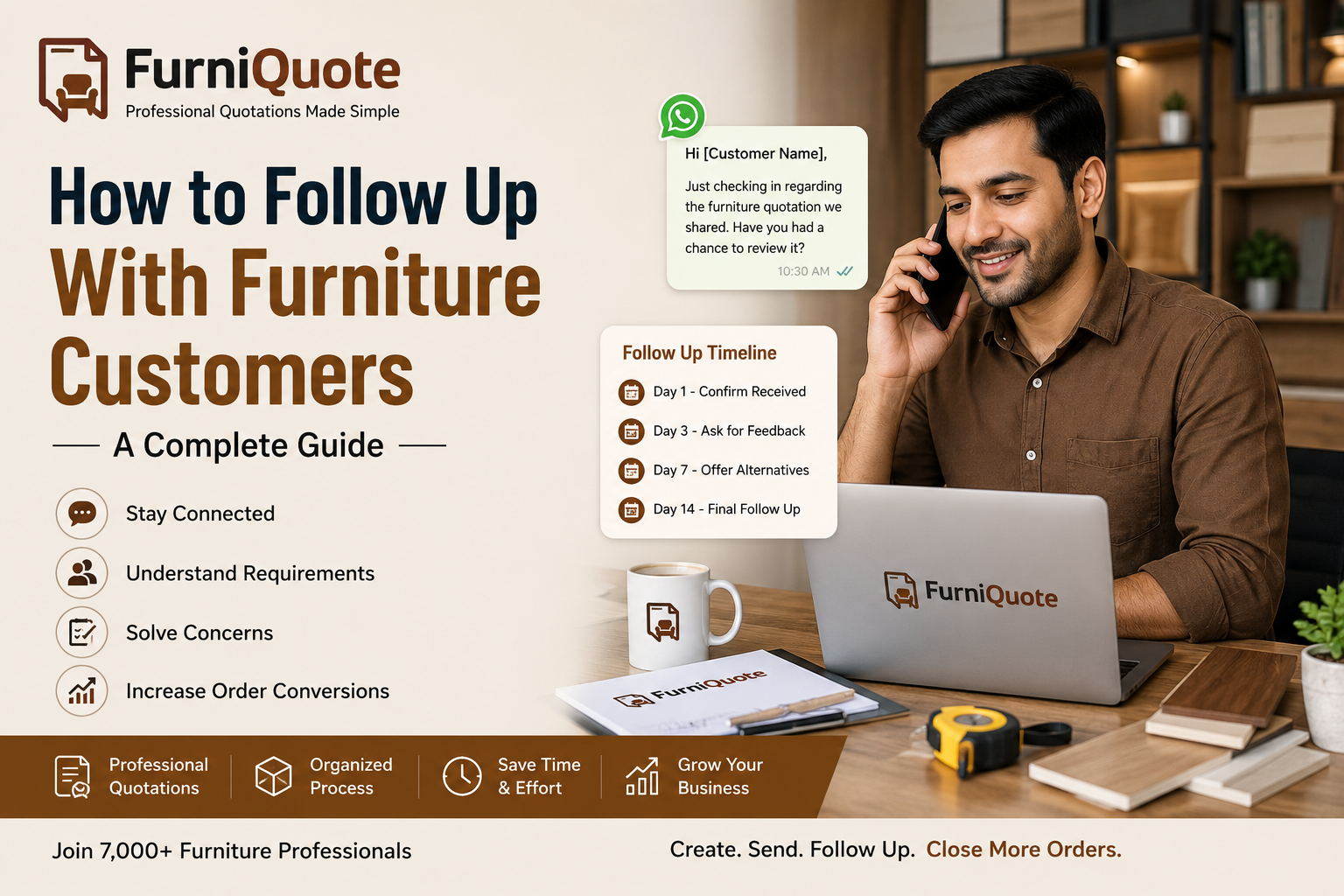
Following up with furniture customers is an important part of running a furniture, interior, modular kitchen, or woodworking business. Sending a quotation is only the beginning of the sales process. A professional and timely follow-up can help you understand the customer's requirements, answer questions, handle price concerns, and increase the chances of converting an enquiry into an order.
Whether you are a furniture manufacturer, carpenter, interior designer, modular kitchen company, or furniture dealer, having a proper customer follow-up process can help you manage more enquiries and avoid losing potential customers.
Why Is Customer Follow-Up Important in the Furniture Business?
Furniture purchases often require customers to compare designs, materials, prices, and different suppliers before making a decision.
A customer may receive your quotation but not immediately place an order. They may be discussing the project with their family, comparing quotations, waiting for construction work, checking their budget, or simply have forgotten to respond.
A good follow-up keeps your business connected with the customer without putting unnecessary pressure on them.
1. Keeps Your Business in the Customer's Mind
Customers may receive quotations from several furniture businesses. A professional follow-up reminds them that you are available to answer their questions and make changes if required.
2. Helps Understand Customer Requirements
A follow-up can reveal why the customer has not confirmed the order.
For example:
- Price is higher than expected
- Customer wants a different design
- Material needs to be changed
- Dimensions need modification
- Customer wants a different finish
- Delivery timeline is important
- Customer is comparing other quotations
Understanding the reason helps you provide a better solution.
3. Increases the Chance of Closing Orders
Many furniture enquiries do not convert after the first quotation.
Consistent and professional follow-up gives you additional opportunities to answer questions, revise the quotation, and move the customer toward a decision.
4. Builds Customer Trust
Customers generally prefer businesses that communicate clearly and respond quickly.
A simple message asking whether they need any clarification can make your business appear more professional and reliable.
When Should You Follow Up With a Furniture Customer?
There is no single follow-up schedule that works for every customer, but a structured process can make things easier.
| Time | Purpose |
|---|---|
| Day 0 | Send quotation |
| Day 1 | Confirm quotation received |
| Day 3 | Ask for feedback |
| Day 7 | Offer changes or alternatives |
| Day 14 | Final follow-up |
The exact timing can be adjusted depending on the size and urgency of the project.
For a small furniture order, the decision may happen quickly. For a complete home interior or modular kitchen project, the customer may need several weeks.
What Should You Say When Following Up?
The most important rule is:
Don't make every follow-up about asking for the order.
Instead of repeatedly asking:
“Have you confirmed the order?”
Try asking:
“Have you had a chance to review the quotation? Please let us know if you need any changes in design, material, quantity, or budget.”
This gives the customer an easy reason to reply.
How to Follow Up With Furniture Customers
1. Follow Up After Sending the Quotation
Once you send the quotation, make sure the customer has received it.
For example:
Hi [Customer Name], thank you for giving us the opportunity to work on your furniture requirement. We have shared the quotation with you. Please let us know if you have any questions or need any changes.
This is a simple first follow-up and does not put pressure on the customer.
2. Ask Whether They Reviewed the Quotation
After giving the customer some time, ask for feedback.
For example:
Hi [Customer Name], just checking whether you had a chance to review the furniture quotation we shared. Please let us know if you have any questions regarding the pricing, materials, or specifications.
This can start a useful conversation.
3. Ask About the Budget
Budget is one of the most common reasons customers delay furniture purchases.
If a customer says:
“Your quotation is too high.”
Don't immediately reduce your price.
First understand the customer's expected budget.
You can ask:
Could you please share your approximate budget? We can check whether we can suggest alternative materials, specifications, or designs that fit your requirement.
This allows you to find a solution without unnecessarily reducing your profit margin.
4. Offer Alternative Materials
Sometimes the customer likes your design but the selected material makes the quotation expensive.
You can offer alternatives such as:
- Plywood
- MDF
- Particle board
- Different laminate
- Different veneer
- Alternative hardware
- Standard accessories
- Different finishing options
For example:
Original Option: Premium plywood + premium hardware
Alternative Option: Standard plywood + standard hardware
This gives the customer a choice instead of simply losing the enquiry.
5. Offer a Revised Quotation
If the customer requests changes, don't treat the revised quotation as a completely new enquiry.
Update the quotation according to the customer's requirements.
For example:
Option A: ₹1,50,000 – Premium specification
Option B: ₹1,25,000 – Standard specification
Option C: ₹1,05,000 – Budget specification
Giving multiple options can make the decision easier.
6. Follow Up About Design Changes
Furniture customers often change their requirements after receiving the quotation.
They may want to change:
- Wardrobe layout
- Kitchen design
- Bed size
- TV unit
- Storage
- Cabinet configuration
- Sofa dimensions
- Office furniture
- Colour
- Laminate
- Hardware
Instead of simply asking for confirmation, ask:
Would you like us to make any changes to the design or specifications before finalizing the quotation?
This can bring an inactive customer back into the conversation.
7. Follow Up Through WhatsApp
WhatsApp can be an effective communication channel for furniture businesses because customers can easily receive quotations, images, designs, and messages.
Keep your WhatsApp follow-up short and professional.
For example:
Hi [Customer Name], we wanted to follow up regarding your furniture quotation. If you need any changes in design, material, quantity, or budget, please let us know. We will be happy to revise it.
Avoid sending multiple messages one after another.
8. Use Phone Calls When Necessary
Sometimes a phone call is more effective than several WhatsApp messages.
A short call can help you understand the customer's concern quickly.
For example:
Hello Sir/Madam, I am calling regarding the furniture quotation we shared. I just wanted to check if everything is suitable or if you need any changes from our side.
Keep the conversation helpful and professional.
If the customer is busy, ask when would be a convenient time to contact them again.
9. Follow Up After Site Measurement
For custom furniture, site measurement can be an important stage of the sales process.
After completing the measurement, keep the customer updated about:
- Measurements
- Design
- Material
- Revised quotation
- Production timeline
- Installation
- Delivery
Regular updates help the customer feel that their project is being handled properly.
10. Use Genuine Urgency
Sometimes a customer needs a reason to make a decision.
If there is a genuine reason, communicate it clearly.
For example:
- Material prices are changing
- Production capacity is limited
- Installation dates are filling up
- A genuine promotional offer is ending
- The customer has a required completion date
Avoid creating fake urgency. Trust is more valuable than a single order.
Furniture Customer Follow-Up Message Templates
After Sending a Quotation
Hi [Customer Name], thank you for giving us the opportunity to work on your furniture requirement. We have shared the quotation with you. Please let us know if you need any changes or clarification.
One-Day Follow-Up
Hi [Customer Name], just checking whether you had a chance to review the furniture quotation we shared. Please feel free to contact us if you have any questions.
Three-Day Follow-Up
Hi [Customer Name], we wanted to follow up regarding your furniture quotation. If you would like any changes in design, material, specifications, or pricing, we can prepare a revised option for you.
Budget Follow-Up
We understand your budget concern. We can explore alternative materials, designs, or specifications to bring the quotation closer to your budget. Would you like us to prepare an alternative option?
Design Follow-Up
Hi [Customer Name], would you like any changes in the furniture design, dimensions, finish, or storage configuration? We can update the quotation based on your requirements.
Final Follow-Up
Hi [Customer Name], just following up one final time regarding your furniture requirement. If the project is still active, we would be happy to update the quotation based on your current requirements. Please feel free to contact us whenever you are ready.
How Many Times Should You Follow Up With a Customer?
There is no need to message a customer every day.
A structured approach is better.
For example:
First follow-up: Confirm they received the quotation.
Second follow-up: Ask for feedback.
Third follow-up: Offer a solution or alternative.
Final follow-up: Politely close the conversation.
If the customer still doesn't respond, give them space. They may return later when their project is ready.
Common Furniture Customer Follow-Up Mistakes
Mistake 1: Asking for the Order Every Time
Repeatedly asking for order confirmation can make the customer feel pressured.
Instead, try to understand their concern.
Mistake 2: Sending Too Many Messages
Sending several WhatsApp messages every day can reduce customer trust.
Give customers enough time to respond.
Mistake 3: Offering Discounts Immediately
If a customer says the price is high, don't immediately offer a discount.
First understand what is causing the price difference.
You may be able to change the material, design, or specifications instead.
Mistake 4: Not Remembering Customer Requirements
If the customer previously discussed a particular material, budget, or design, remember those details during the next conversation.
This makes your follow-up more professional.
Mistake 5: Not Tracking Follow-Ups
If you have many enquiries, it is easy to forget who needs a follow-up.
You should keep track of:
- Customer name
- Contact details
- Requirement
- Quotation number
- Quotation date
- Follow-up date
- Customer response
- Revised quotation
- Order status
How to Track Furniture Customer Follow-Ups
A simple tracking system can look like this:
| Customer | Quotation | Date Sent | Next Follow-Up | Status |
|---|---|---|---|---|
| Customer A | ₹85,000 | Sept 1 | Sept 3 | Waiting |
| Customer B | ₹1,25,000 | Sept 1 | Sept 4 | Interested |
| Customer C | ₹65,000 | Aug 29 | Sept 2 | Revision |
| Customer D | ₹2,10,000 | Aug 25 | Sept 1 | Negotiation |
This makes it easier to identify which customers require attention.
How Technology Can Make Furniture Follow-Up Easier
Managing customer quotations manually through Excel files, notebooks, calculators, documents, and WhatsApp messages can become difficult as your business grows.
A structured digital quotation system can help organize the quotation process and make it easier to manage customer requirements.
With FurniQuote, furniture professionals can create professional quotations and streamline their quotation workflow.
Instead of spending unnecessary time preparing and managing quotations manually, businesses can focus more on:
- Getting new enquiries
- Following up with customers
- Revising quotations
- Closing orders
- Managing projects
A professional quotation combined with a consistent follow-up process can create a better customer experience.
A Simple Furniture Sales Follow-Up Process
Customer Enquiry
↓
Understand Requirement
↓
Prepare Design & Pricing
↓
Send Professional Quotation
↓
Confirm Customer Received It
↓
Follow Up for Feedback
↓
Understand Objections
↓
Revise Quotation if Required
↓
Negotiate & Finalize
↓
Confirm Order
↓
Production
↓
Delivery & Installation
↓
After-Sales Follow-Up
This turns customer follow-up into a proper sales process instead of random messages.
Final Checklist for Furniture Customer Follow-Up
Before following up with a customer, check:
☑ Customer name
☑ Quotation number
☑ Quotation date
☑ Customer requirement
☑ Quoted price
☑ Material specifications
☑ Design details
☑ Previous conversation
☑ Customer's budget, if known
☑ Last follow-up date
☑ Customer's response
☑ Any requested changes
☑ Next follow-up date
Conclusion
Following up with furniture customers is not about sending more messages. It is about communicating at the right time and providing the right information.
A good follow-up helps you understand customer concerns, answer questions, offer alternatives, revise quotations, and build trust.
Remember:
Don't chase the customer. Help the customer make a decision.
Whether you are a furniture manufacturer, carpenter, interior designer, modular kitchen company, or furniture dealer, a structured quotation and follow-up process can help you manage enquiries more professionally.
A good quotation starts the conversation. A good follow-up helps close the deal.
 Get on Play Store