A furniture quotation is more than just a price on paper. It is often the first detailed document a customer receives from your business.
A clear and professional quotation can make your business look trustworthy, help customers understand exactly what they are paying for, and increase the chances of converting an inquiry into an order.
Whether you are a carpenter, furniture manufacturer, interior furniture contractor, or furniture showroom owner, learning how to prepare a professional quotation can make a big difference.
Here are the important things you should include in every furniture quotation.
1. Add Your Business Information
Start your quotation with your business name, logo, phone number, address, and other important contact details.
A customer should immediately know who prepared the quotation and how to contact you.
A professional header creates a better first impression than a simple handwritten price message.
2. Add Customer Details
Always mention the customer's name and contact information.
If the quotation is for a specific project, also mention the project name or location.
For example:
Customer: Rajesh Patel
Project: 3 BHK Furniture Work
Location: Rajkot
This makes the quotation easier to identify later.
3. Give Every Furniture Item a Clear Description
Don't simply write:
Wardrobe – ₹50,000
Instead, provide useful details such as:
- Furniture item
- Size or measurement
- Material
- Finish
- Quantity
- Price
The more clearly you explain the work, the fewer misunderstandings you will have later.
4. Mention Measurements Clearly
Furniture work depends heavily on measurements.
Include dimensions such as length, width, height, running feet, square feet, or other relevant measurements.
This helps both you and your customer understand how the price was calculated.
5. Show the Price Clearly
Your customer should not have to calculate the final amount themselves.
Clearly show:
- Item price
- Quantity
- Subtotal
- Additional charges, if applicable
- Discount, if applicable
- Final amount
A simple and organized price breakdown makes your quotation much easier to understand.
6. Explain the Material and Specifications
Two furniture products can look similar but have very different costs depending on the materials used.
Mention important specifications such as:
- Board or wood type
- Thickness
- Hardware
- Laminate or finish
- Accessories
- Brand of hardware, if relevant
This helps the customer understand why your quotation has a particular price.
7. Clearly Mention What Is Included
One common source of disputes is unclear scope of work.
Mention what is included in the quoted price.
For example:
- Manufacturing
- Transportation
- Installation
- Hardware
- Finishing
- Accessories
If something is not included, mention that clearly as well.
8. Mention Payment Terms
Always explain how payments will be collected.
For example:
Advance: 50%
During Production: 40%
Final Payment: 10%
The exact payment structure can vary depending on your business and project.
Clear payment terms help avoid confusion later.
9. Add the Expected Delivery Timeline
Customers want to know when their furniture will be ready.
Instead of making a vague promise like "soon," provide a realistic estimated timeline.
For example:
Estimated completion: 20–25 working days after confirmation and advance payment.
Always give yourself a realistic buffer rather than promising an impossible deadline.
10. Add Quotation Validity
Material and hardware prices can change.
Therefore, it is useful to mention how long the quotation remains valid.
For example:
Quotation valid for 15 days from the quotation date.
This gives you more flexibility if material prices change later.
11. Add Your Terms and Conditions
Important terms should be written clearly.
Depending on your business, these may include:
- Changes after order confirmation
- Cancellation policy
- Delivery conditions
- Installation conditions
- Payment conditions
- Material availability
- Warranty terms
Clear terms protect both the customer and the business.
12. Use Your Business Logo
Your quotation should look like it belongs to your business.
Adding your logo, business name, and consistent branding makes the document look more professional.
Customers are more likely to trust a quotation that looks organized and properly prepared.
13. Avoid Sending Only a Price on WhatsApp
Many furniture businesses send customers a simple WhatsApp message such as:
"Kitchen ₹1,80,000."
This may be quick, but it doesn't communicate the full value of your work.
Instead, send a proper quotation containing the project details, specifications, pricing, payment terms, and other important information.
You can still send the quotation through WhatsApp—just make sure the document itself is professional.
14. Send the Quotation Quickly
Speed matters.
If a customer has contacted several furniture businesses, the first professional quotation may get more attention.
Try to prepare and send the quotation as soon as you have enough information to calculate the project accurately.
Fast response + professional quotation = better chance of conversion.
15. Follow Up After Sending the Quotation
Sending a quotation is not the end of the sales process.
Many customers need time to discuss the price with their family or compare options.
Follow up politely after a reasonable amount of time.
For example:
"Hello Rajesh Bhai, I wanted to check whether you had a chance to review the furniture quotation. Please let me know if you have any questions or would like to discuss any changes."
A professional follow-up is much better than repeatedly asking:
"Order final?"
16. Don't Compete Only on Price
If your quotation only shows one final number, customers may compare you entirely on price.
Instead, communicate your value.
Explain the materials, quality, workmanship, hardware, finishing, installation, service, and other benefits included in your quotation.
Customers don't always choose the cheapest furniture business. They often choose the business they trust.
17. Keep a Record of Every Quotation
Don't depend on WhatsApp chats or notebooks alone.
Maintain a record of:
- Customer
- Quotation number
- Quotation date
- Amount
- Status
- Follow-up date
- Confirmed or rejected
This helps you understand how many inquiries are actually becoming orders.
18. Track Your Quotation Conversion Rate
Suppose you sent 30 quotations this month and received 10 orders.
Your quotation conversion rate is approximately 33%.
Tracking this number helps you understand your sales performance.
If your conversion rate is low, you can investigate whether the problem is pricing, follow-up, quotation quality, response time, or something else.
19. Don't Forget Follow-Up Dates
A common mistake is preparing a quotation and then forgetting about it.
Create a simple follow-up system.
For example:
Day 1: Send quotation
Day 3: First follow-up
Day 7: Second follow-up
Day 15: Final follow-up
The exact timing can vary depending on the project and customer.
20. Make Your Quotation Easy to Understand
Professional doesn't mean complicated.
Your quotation should be:
- Clear
- Simple
- Organized
- Easy to read
- Easy to share
- Easy to understand
Avoid unnecessary information that makes the document confusing.
Common Furniture Quotation Mistakes to Avoid
Here are some mistakes that can make a quotation look unprofessional:
- Sending only a total price.
- Not mentioning measurements.
- Not explaining materials.
- Forgetting payment terms.
- Giving unrealistic delivery dates.
- Not mentioning quotation validity.
- Not including the business name or contact details.
- Sending poorly formatted documents.
- Forgetting to follow up.
- Not keeping a record of quotations.
A Simple Professional Furniture Quotation Structure
A good furniture quotation can follow this structure:
Business Information
↓
Customer & Project Details
↓
Furniture Items & Measurements
↓
Materials & Specifications
↓
Item-wise Pricing
↓
Total Amount
↓
Payment Terms
↓
Delivery Timeline
↓
Terms & Conditions
↓
Business Contact Details
This simple structure can make your quotation much easier for customers to understand.
Use Digital Tools to Save Time
Preparing every quotation manually can take a lot of time, especially when you are handling multiple customers.
Digital tools can help furniture businesses create quotations faster, maintain customer records, keep quotation history organized, and track payments.
Instead of searching through notebooks and WhatsApp conversations, you can keep important business information in one place.
Final Thoughts
A professional quotation can do much more than show a price.
It can communicate your quality, explain your value, build customer confidence, reduce misunderstandings, and help you convert more inquiries into confirmed orders.
For furniture businesses, improving the quotation process is one of the simplest ways to become more organized and professional.
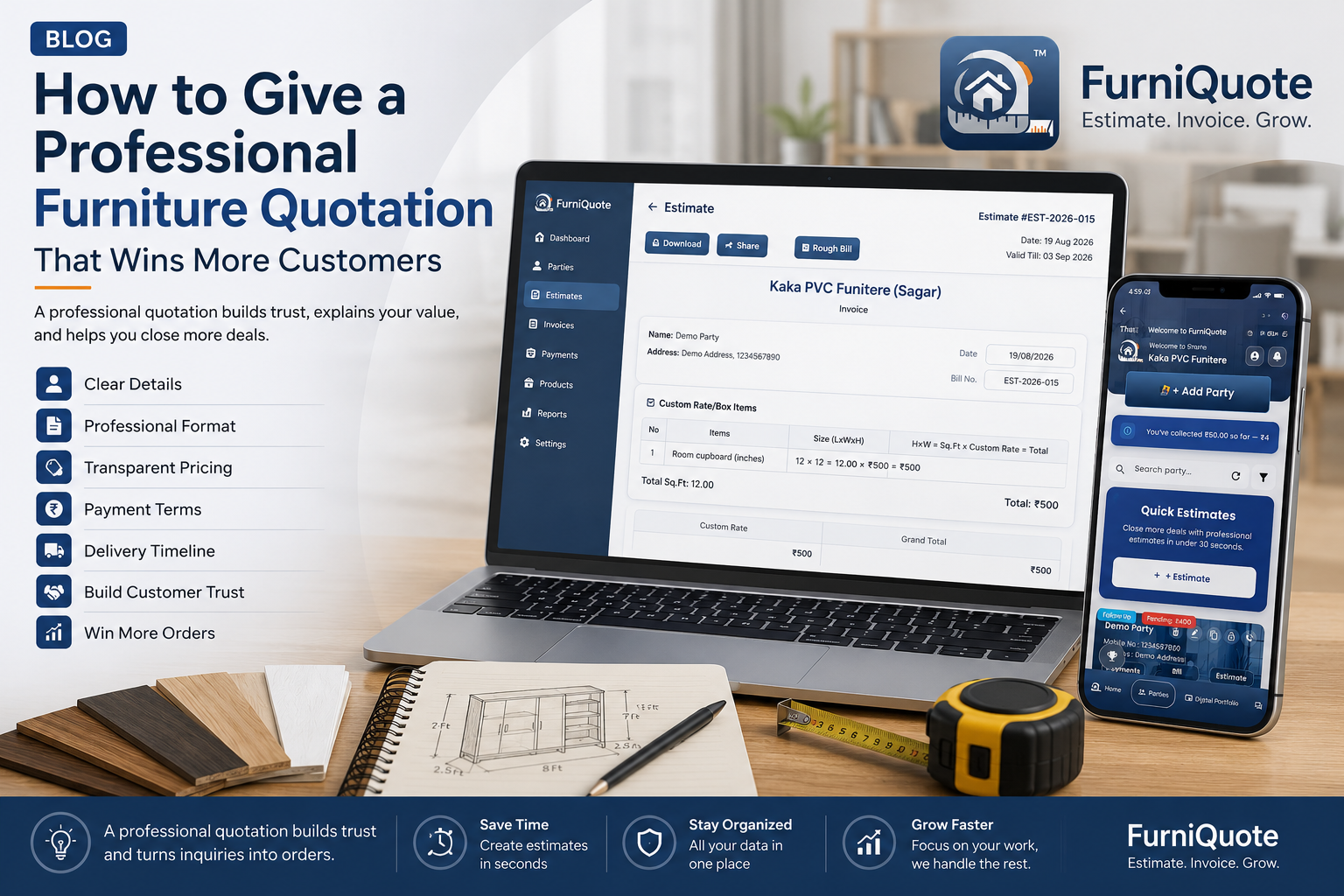
FurniQuote helps furniture businesses create professional estimates and invoices, manage customers, and keep track of payments in one place—so you can spend less time on paperwork and more time growing your business.
Estimate. Invoice. Grow.
 Get on Play Store