Tracking customer payments is one of the most important parts of running a furniture, carpentry, modular kitchen, interior, or woodworking business.
A project may be profitable on paper, but if customer payments are delayed or not properly tracked, your cash flow can suffer. You may have to purchase plywood, hardware, laminate, accessories, and other materials before receiving the money from your customer.
Many furniture businesses still track payments through notebooks, WhatsApp messages, spreadsheets, or memory. This can work when you have only a few customers, but it becomes difficult as your number of projects grows.
A proper payment tracking system helps you know who has paid, who has a balance, how much is due, and when the next payment is expected.
Why Customer Payment Tracking Is Important
Furniture projects often involve multiple stages and payments.
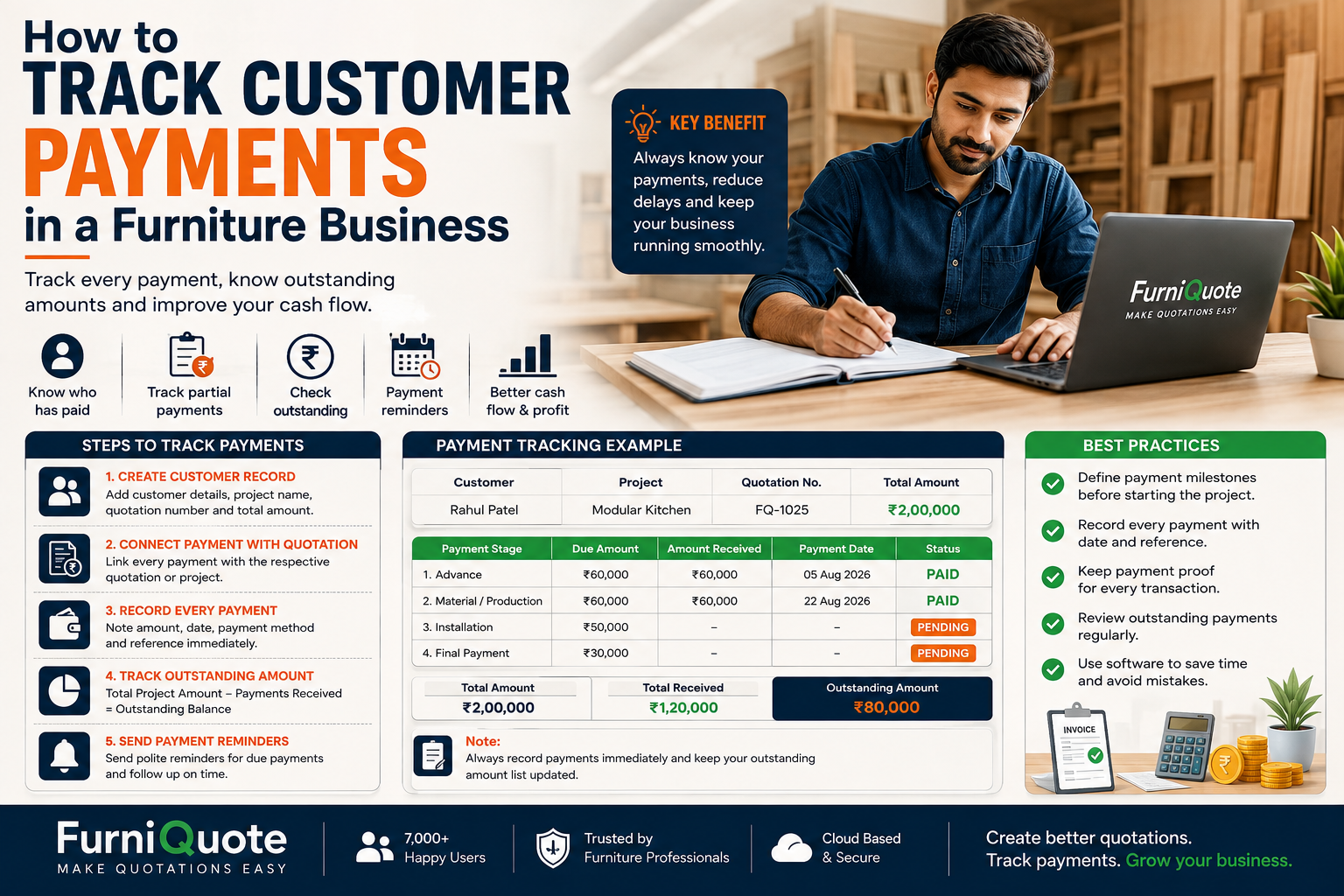
For example, a ₹2,00,000 modular kitchen project might have:
₹60,000 advance
₹60,000 after material procurement
₹50,000 during installation
₹30,000 final payment
If these payments are not recorded properly, it becomes easy to forget outstanding amounts.
Poor payment tracking can result in:
Delayed cash flow
Forgotten outstanding payments
Confusion about customer balances
Difficulty matching payments with projects
Disputes over payment history
Problems managing material purchases
Reduced business profitability
Good payment tracking gives you a clear financial picture of every project.
1. Start With a Clear Customer Record
Every customer should have a separate record.
At minimum, maintain:
Customer name
Mobile number
Project name
Project location
Quotation number
Total quotation amount
Amount received
Outstanding amount
Payment dates
Payment method
Notes
For example:
Customer: Rahul Patel
Project: Modular Kitchen
Quotation: FQ-1025
Total: ₹2,00,000
Received: ₹1,20,000
Outstanding: ₹80,000
This immediately tells you the current payment position.
2. Connect Payments With the Quotation
One of the easiest ways to create confusion is to track quotations and payments separately.
Your quotation should be the starting point for payment tracking.
Suppose your quotation total is:
₹3,50,000
Customer payments should then be recorded against that specific quotation.
Your record could look like:
| Payment | Amount | Status |
|---|---|---|
| Advance | ₹1,00,000 | Paid |
| Second Payment | ₹1,00,000 | Paid |
| Third Payment | ₹75,000 | Paid |
| Final Payment | ₹75,000 | Pending |
Now you can instantly see that ₹75,000 is still outstanding.
3. Record Every Payment Immediately
Don't depend on memory.
Whenever a customer makes a payment, record it immediately.
Include:
Payment amount
Payment date
Payment method
Transaction/reference number, when applicable
Related quotation/project
Remaining balance
For example:
Payment Received: ₹50,000
Date: 1 September 2026
Method: Bank Transfer
Quotation: FQ-1025
Remaining Balance: ₹75,000
Recording payments immediately prevents mistakes later.
4. Track Partial Payments
Furniture projects commonly involve partial payments.
A customer may not pay the entire quotation amount at once.
For example:
Project Value: ₹4,00,000
Payment 1: ₹1,00,000
Payment 2: ₹1,25,000
Payment 3: ₹1,00,000
Balance: ₹75,000
Your payment tracking system should automatically calculate:
Outstanding = Total Project Amount − Total Payments Received
This is much safer than manually calculating balances every time.
5. Set Payment Milestones
For larger projects, divide payments according to project milestones.
For example:
Furniture Project Payment Schedule
30% — Advance
Payment before procurement or production begins.
30% — Material/Production Stage
Payment when materials are procured or production begins.
30% — Installation Stage
Payment before or during installation.
10% — Final Payment
Payment after completion and handover.
The exact percentages should depend on your business, project type, and agreement with the customer.
The important point is to define the payment schedule before the project starts.
6. Track Outstanding Payments
Your business should always know its total outstanding amount.
For example:
| Customer | Project | Total | Paid | Outstanding |
|---|---|---|---|---|
| Customer A | Kitchen | ₹2,50,000 | ₹2,00,000 | ₹50,000 |
| Customer B | Wardrobe | ₹1,50,000 | ₹1,00,000 | ₹50,000 |
| Customer C | TV Unit | ₹80,000 | ₹80,000 | ₹0 |
| Customer D | Office Furniture | ₹3,00,000 | ₹1,50,000 | ₹1,50,000 |
Total outstanding:
₹2,50,000
This number is extremely important for managing business cash flow.
7. Don't Mix Customer Payments With Project Costs
Another common mistake is looking only at the amount received.
Suppose:
Customer paid: ₹1,00,000
It may look like good cash flow.
But if you have already spent:
Materials: ₹70,000
Labour: ₹20,000
Transportation: ₹10,000
then the entire ₹1,00,000 has already been consumed by project costs.
That's why payment tracking should ideally be viewed together with project costs and profitability.
A useful business calculation is:
Project Revenue − Project Costs = Project Profit
And:
Total Quotation − Payments Received = Outstanding Amount
Both numbers should be visible to the business owner.
8. Send Payment Reminders Professionally
When a payment becomes due, don't wait until the customer asks about it.
Send a polite payment reminder.
A good reminder should include:
Customer name
Project name
Invoice/quotation reference
Amount due
Payment milestone
Due date
Payment instructions
Keep the message professional and friendly.
For example:
"Hello Rahul, your ₹50,000 payment for the modular kitchen project is due as per the agreed payment milestone. Please arrange the payment so we can proceed with the next stage of the project. Thank you."
9. Keep Payment Proof
For every payment, maintain an appropriate record or proof.
Depending on the payment method, this could include:
Bank transaction reference
UPI transaction reference
Receipt number
Cheque details
Cash receipt
Payment confirmation
This becomes particularly useful when handling multiple projects at the same time.
10. Use Software Instead of Manual Tracking
As your furniture business grows, manually tracking payments becomes increasingly difficult.
You may have:
Dozens of quotations
Multiple ongoing projects
Different payment milestones
Several customers making partial payments
Multiple employees
Hundreds of transactions
A software-based system can make this much easier.
With FurniQuote, furniture professionals can manage their quotation workflow digitally and keep project-related financial information more organized.
Instead of searching through notebooks or WhatsApp conversations, you can work from structured customer and quotation records.
Example: Simple Customer Payment Tracking
Imagine you have a wardrobe project worth:
₹1,80,000
The customer makes three payments:
Advance: ₹60,000
Production: ₹70,000
Final: ₹50,000
Your payment record becomes:
| Stage | Amount | Status |
|---|---|---|
| Advance | ₹60,000 | Paid |
| Production | ₹70,000 | Paid |
| Final | ₹50,000 | Paid |
| Total | ₹1,80,000 | Fully Paid |
If the customer pays only ₹1,30,000, the system should clearly show:
Total: ₹1,80,000
Paid: ₹1,30,000
Outstanding: ₹50,000
That simple visibility can make a big difference to cash-flow management.
Common Payment Tracking Mistakes
Avoid these mistakes:
❌ Tracking payments only in WhatsApp
Messages can get buried among hundreds of conversations.
❌ Depending on memory
As your customer base grows, remembering every payment becomes unreliable.
❌ Not recording partial payments
A customer may have paid ₹50,000, but without a proper record it can be difficult to know the remaining balance.
❌ Not connecting payments to quotations
Always identify which project or quotation a payment belongs to.
❌ Forgetting final payments
Small outstanding balances across many customers can become a significant amount.
❌ Not sending reminders
Delayed reminders can unnecessarily delay your cash flow.
Customer Payment Tracking Checklist
Before considering a project financially complete, check:
☑ Customer and project identified
☑ Quotation number recorded
☑ Total project value recorded
☑ Every payment recorded
☑ Payment dates recorded
☑ Payment methods recorded
☑ Partial payments updated
☑ Outstanding balance calculated
☑ Payment reminders sent when required
☑ Final payment confirmed
Final Thoughts
Good payment tracking is not just accounting work—it is an important part of running a profitable furniture business.
When you always know your total sales, payments received, outstanding balances, and project status, you can make better decisions about purchasing materials, paying workers, starting new projects, and managing cash flow.
For a growing carpenter, furniture manufacturer, modular kitchen business, or interior professional, moving from notebooks and scattered WhatsApp messages to a structured digital workflow can save time and reduce mistakes.
Manage Your Furniture Quotations More Professionally With FurniQuote
From creating professional quotations to organizing customer and project information, FurniQuote is built for furniture and woodworking professionals.
With 7,000+ users, FurniQuote helps furniture professionals make their quotation process more organized and professional.
Create better quotations. Track your projects. Manage your business more efficiently.
 Get on Play Store