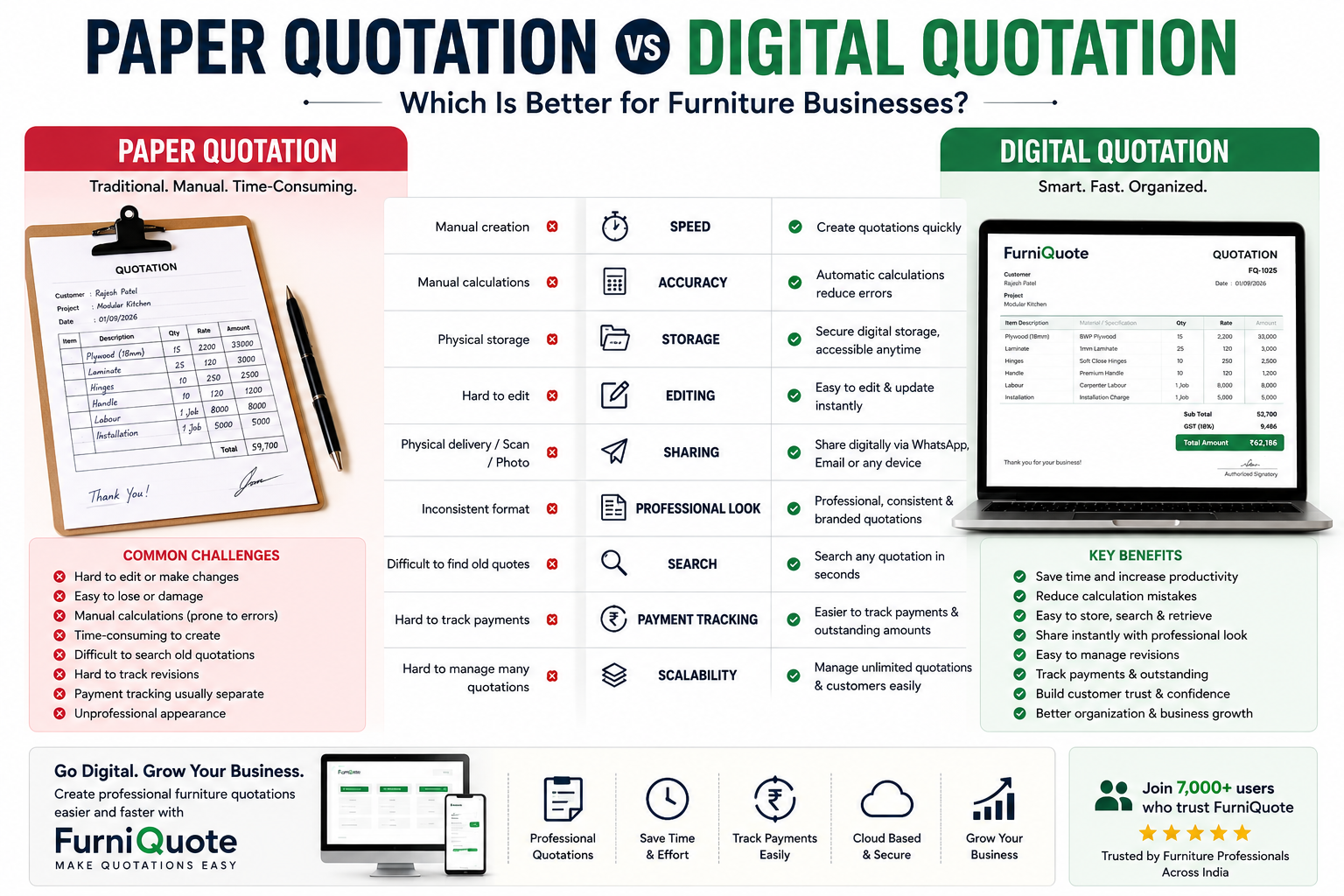
For years, carpenters, furniture manufacturers, interior contractors, modular kitchen businesses, and woodworking professionals have created quotations using paper, notebooks, printed formats, or handwritten estimates.
Paper quotations are simple and familiar. But as a furniture business grows, managing dozens or hundreds of quotations, customers, revisions, payments, and project details can become difficult.
This is where digital quotations can make a major difference.
So, which is better for a modern furniture business: paper quotation or digital quotation?
Let's compare both.
What Is a Paper Quotation?
A paper quotation is a physical document containing the details and price of a proposed furniture or carpentry project.
It may include:
Customer name
Furniture details
Measurements
Materials
Quantity
Labour charges
Price
Total amount
Terms and conditions
Signature
A carpenter may write the quotation manually in a notebook, prepare it on paper, or print it from a computer.
Advantages of Paper Quotations
Paper quotations have some benefits:
Easy to create without software
Familiar to many traditional businesses
Can be signed physically
Useful when internet or technology is unavailable
Can be handed directly to a customer
For a small business with only a few quotations, this may seem sufficient.
However, problems often appear when the number of customers and projects increases.
What Is a Digital Quotation?
A digital quotation is a quotation created and stored electronically using software or an online quotation system.
Instead of writing every quotation manually, you can enter customer, product, material, quantity, and pricing information into a digital system.
A digital quotation can then be:
Created quickly
Edited when required
Saved electronically
Shared digitally
Printed when necessary
Referenced later
Connected with customer/project information
For a growing furniture business, this can make quotation management significantly easier.
Paper Quotation vs Digital Quotation
| Feature | Paper Quotation | Digital Quotation |
|---|---|---|
| Creation | Usually manual | Software-assisted |
| Editing | Rewrite or manually modify | Easy to update |
| Storage | Physical files | Digital storage |
| Searching | Time-consuming | Fast |
| Sharing | Hand delivery/scan/photo | Digital sharing |
| Calculations | Manual | Can be automated |
| Professional formatting | Depends on template | Consistent |
| Backup | Physical copy | Digital backup options |
| Tracking revisions | Difficult | Easier |
| Customer history | Separate records | Can be organized digitally |
| Payment tracking | Usually separate | Can be connected to workflow |
| Multiple quotations | Difficult to manage | Easier to manage |
1. Speed: Paper vs Digital
Imagine a carpenter needs to prepare five quotations today.
With paper quotations, the process may involve:
Find the quotation book or template.
Write customer details.
Calculate quantities.
Calculate prices.
Add taxes or other charges.
Check the calculations.
Write terms and conditions.
Sign the quotation.
Scan or photograph it.
Send it to the customer.
A digital quotation system can reduce many of these repetitive steps.
Customer and business information can be entered into a structured quotation, calculations can be handled automatically, and the finished quotation can be shared digitally.
Winner: Digital Quotation
2. Accuracy: Manual Calculations vs Automated Calculations
Furniture quotations often contain many line items.
For example:
18mm plywood
12mm plywood
Laminate
Edge band
Hinges
Channels
Handles
Labour
Installation
Transportation
A single calculation mistake can affect the final quotation.
With paper quotations, calculations are often done manually.
Digital quotation software can calculate quantities, rates, subtotals, taxes, discounts, and totals automatically, depending on the system.
This can reduce repetitive calculation errors.
Winner: Digital Quotation
3. Storage and Organization
Paper quotations require physical storage.
If you have 20 customers, this may not be a major problem.
But imagine having:
100 customers → 300 quotations → multiple revisions per project
Finding an old quotation in a stack of papers can become frustrating.
Digital records can be organized by:
Customer
Quotation number
Project
Date
Status
You can search for the information instead of going through physical files.
Winner: Digital Quotation
4. Making Changes to a Quotation
Furniture projects often change.
A customer might say:
"Change the laminate."
Then:
"Add two drawers."
Then:
"Increase the wardrobe height."
Then:
"Remove this cabinet."
With a paper quotation, every major change may require rewriting or reprinting the document.
With a digital quotation, you can update the relevant item and generate the revised quotation.
This is particularly useful for customized furniture projects.
Winner: Digital Quotation
5. Professional Appearance
Customers judge a business not only by its furniture but also by how professionally the business communicates.
A quotation containing:
Business branding
Customer information
Itemized products
Material specifications
Quantities
Rates
Taxes
Terms
Total amount
can create a more organized impression than a handwritten price on a piece of paper.
Paper quotations can also look professional if you use a well-designed printed template.
However, digital systems make consistent formatting easier.
Winner: Digital Quotation
6. Sharing With Customers
Paper quotations usually require:
Physical delivery
Scanning
Photographing
Printing
Sending a scanned copy
Digital quotations are designed for electronic sharing.
You can send them through the communication channels your business uses, depending on your workflow.
This can be particularly useful when your customer is in another city or is communicating remotely.
Winner: Digital Quotation
7. Finding Old Quotations
Customer calls:
"Can you send me the quotation you gave me three months ago?"
With paper records, you may need to search through files.
With a digital quotation system, you can search using information such as:
Customer → Project → Quotation
This saves time and makes customer follow-up easier.
Winner: Digital Quotation
8. Payment and Outstanding Amounts
A quotation is often only the beginning of a furniture project.
After the quotation is approved, you may need to track:
Advance payment
Material payment
Production payment
Installation payment
Final payment
Outstanding balance
With paper-based workflows, payment tracking may happen separately in a notebook or spreadsheet.
A connected digital workflow can make it easier to associate payment information with the relevant customer and project.
Winner: Digital Quotation
9. Paper Is Not Always the Problem
It is important to understand that paper quotations are not automatically bad.
For a carpenter who creates only a few quotations each month, paper may still be practical.
The problem starts when your business grows and you have to manage:
More customers
More projects
More quotations
More revisions
More payments
More employees
More customer follow-ups
At that point, manual processes can consume valuable time.
When Should a Carpenter Switch to Digital Quotations?
There is no fixed number of customers at which every business must switch.
But consider moving to digital quotations when you frequently experience:
☑ Difficulty finding old quotations
☑ Calculation mistakes
☑ Rewriting quotations
☑ Lost paperwork
☑ Customer disputes about quoted prices
☑ Difficulty tracking revisions
☑ Delayed quotation sharing
☑ Difficulty tracking outstanding payments
☑ Too much time spent preparing quotations
If several of these problems sound familiar, digital quotation software may be worth considering.
Why FurniQuote Is Useful for Furniture Businesses
FurniQuote is designed specifically around the quotation needs of furniture and woodworking professionals.
Instead of creating every quotation from scratch, you can build structured furniture quotations containing relevant project information, products, quantities, pricing, and business details.
This can help carpenters, furniture manufacturers, modular kitchen businesses, interior professionals, and other woodworking businesses create quotations more efficiently.
With 7,000+ users, FurniQuote is helping furniture professionals move toward a more organized quotation workflow.
Paper vs Digital: The Simple Answer
If you create only a handful of quotations and don't have problems managing them, paper can still work.
But if your business is growing and you are managing many customers, projects, revisions, and payments, digital quotations provide significant advantages.
The biggest difference isn't simply paper versus computer.
It is:
Manual quotation management vs organized digital workflow.
A modern furniture business needs to spend more time building great furniture and serving customers—and less time searching through notebooks, recalculating totals, and rewriting quotations.
Final Verdict
Paper Quotation
Best for: Small-scale, low-volume, traditional workflows.
Main advantage: Simple and familiar.
Main limitation: Difficult to scale and organize.
Digital Quotation
Best for: Growing carpenters, furniture businesses, interior professionals, and manufacturers.
Main advantage: Faster, organized, searchable, and easier to manage.
Main limitation: Requires adopting a digital system and workflow.
The Bottom Line
Paper helped furniture businesses manage quotations for decades.
But as your business grows, digital quotation management can help you work faster, reduce repetitive errors, stay organized, and provide a more professional customer experience.
Create professional furniture quotations faster with FurniQuote.
 Get on Play Store